
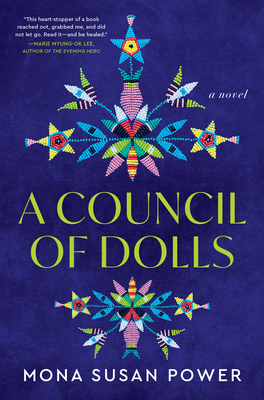
A Council of Dolls by Mona Susan Power recounts a family saga through the generational trauma of “Indian Boarding Schools.” The book follows three woman from each generation, starting with Sissy in 1960s Chicago. Her parents are both boarding school survivors and have effectively been forced to move to a city for jobs and resources. Sissy is at odds with her mother, Lillian, who she both greatly fears and loves. Lillian carries her trauma as an adult and projects it onto her daughter, who never knows where her unpredictable behavior will take the day. Sissy’s father, Cornelius, is loving but somewhat closed off given his own boarding school experiences as well as his time serving in the Korean War. In light of these tenuous relationships, Sissy turns to her doll, Ethel (a gift from her father) as her friend and confidant. Ethel is enigmatic, almost mystical in her abilities leaving the reader wondering if the doll is simply a form of an imaginary friend for Sissy or something more.
The next section of Council is dedicated to Lillian’s experience in the 1930s in a boarding school in Bismark. When school is not in session, Lillian is at home on the reservation with her siblings, mother Cora, and abusive and alcoholic father Jack. Both Cora and Jack are survivors of the Carlisle Indian Industrial School, their trauma surfacing in myriad ways but most detrimental through Jack. Like her daughter some thirty years on, Lillian finds solace in her doll Mae who is perhaps imaginary, perhaps something more. Lillian’s sister Blanche is also fiercely protective of her, her other siblings, and their mother. Blanche fights against her father’s abuse, as well as the abuse she, her sister, and other classmates suffer at the hands of the nuns in their boarding school.
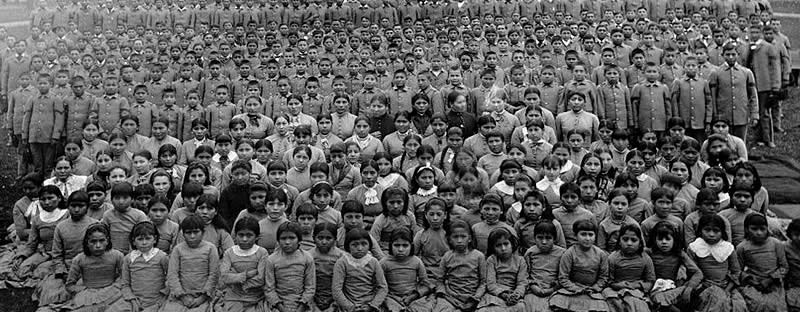
The early 1900s section follows Cora at the Carlisle School. I found Cora’s story to be the most moving and engaging and would have loved to have read an entire novel just about her. Cora meets Jack, whose father is a white soldier, on the train to the school and the two become fast friends. While Carlisle does not allow fraternization between members of the same tribe, Cora still finds sisterhood and found family with students from other tribes from other parts of the country. The students bolster each other and care for each other in the face of abuse and the stripping of their tribal identities. Cora takes an old cornhusk doll with her and is soon visited by the spirit of a murdered ancestor. The doll, Winona, is said to have witnessed a massacre and carries within her sewn body the trauma of the day. While Winona also serves as a confidant to Cora, she also seems to be the embodiment of the murdered ancestor.
The last section of Council threw me a bit, as the reader is taken back to Sissy in her 50s in the year 2010 as she reflects on her family’s generational trauma. The story becomes meta as Sissy, now called Jesse, begins to write her own story about the generations of women in her family, as well as their dolls. This section felt very autobiographical to the author. The author’s note confirms that Power indeed used her own family’s experiences as basis for many of the stories told in Council.
For anyone who does not know much about the “Indian Boarding Schools,” I highly suggest you read A Council of Dolls to gain a full and personal picture of the systemic stripping of tribal identities (cutting hair, burning personal possessions and clothes, forbidden from using tribal languages, etc.) abuse, and even death so many native children experienced. It is sobering to think we are only a generation or two removed from the trauma so many indigenous peoples experienced at these residential schools.
 Home
Home 