
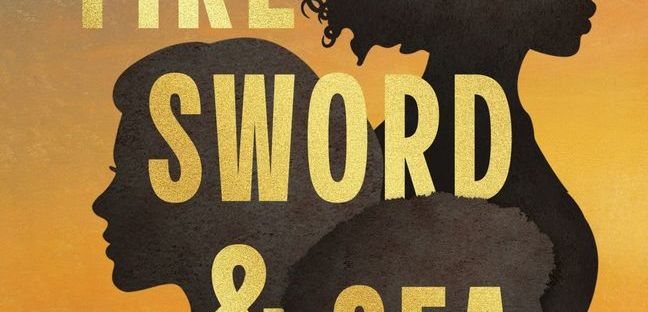

Fire Sword & Sea by Vanessa Riley follows 17th century pirate Jacquotte Delahaye, who may or may not have been a real person or an amalgam of people (women disguised as men, operating as buccaneers during that period. The daughter of a French man and “Guinea” (Haitian) woman, Jacquotte’s childhood and early young adult life is spent working at her father’s tavern in the Caribbean. Jacquotte’s mother, having died very early in Jacquotte’s life, has left behind a legacy of renown for which Jacquotte feels she must live up to and honor in her own actions.
She befriends a “Blanc” woman neighbor, Sarah, who struggles in her abusive marriage. Observing the injustices against women of all races, Jacquotte and Sarah cook up a plan to free imprisoned women set to be sold off as chattel brides. Barely into her teens, Jacquotte steals into the fort and frees several women while Sarah provides the safehouse for those who have fled.
I fould the first half of Fire Sword & Sea to be engaging and fast-paced as Jacquotte brushes the edges of the buccaneer sailor lifestyle she wishes to achieve. For as much as I enjoyed the first half, for some reason the second half didn’t capture my attention as much even though it was filled with a lot of action sequences. I think I may have felt that way because Jacquotte somewhat achieves her goal half-way through the book. I also struggled connecting to the relationship Jacquotte has with a character named Lizzoa, who helps her achieve her dream. The relationship felt rushed, the intimacy happening very fast thereafter, and I never felt fully invested. Without giving too much away, when Jacquotte and Lizzoa begin serving in disguise on a ship together, Lizzoa confusingly still goes by her name while Jacquotte goes by Jacques. They join forces with a handful of women also disguised as men to serve aboard the ship, but the all at once reveal of this group didn’t quite feel believable. Of course there were countless women throughout history who disguised themselves as men to serve aboard a ship or to be a soldier, but to have a handful of these women reveal themselves all the once, in the same place felt a little too convenient. I also felt the last maybe 30% of the book was rushed, as if the author’s editor or publisher forced her to cut several thousands words to then condense important events into a few sentences throughout–which is a shame. I’ve been there and have had to navigate that in my own writing, but I would have liked if the author had been given the time and space to flesh out some events more for in-world believability.
Vanessa Riley paints an accurately diverse time and place in that ship crews would have been made up of people from around the world. Pirate ships were mostly egalitarian in terms of race, class, etc. The author also explores gender roles and sexuality in a thoughtful way that I am sure many will appreciate. While the modern language and terms for certain individuals did not exist in the 17th century, Riley paints a descriptive enough picture within the context of the time for us to understand it. However, there were a few instances of the term “Indigenous” being used when I believe people at that time/place would have instead referred to specific tribes by name (like the Taíno, for example.)
The context of the time meant that for women to attain true freedom they must disguise themselves as men. In time, however, Jacquotte is able to live fully and unapologetically as herself, a pirate captain who stands on her own two feet.
Fire Sword & Sea will be released January 13, 2026
 Home
Home 