
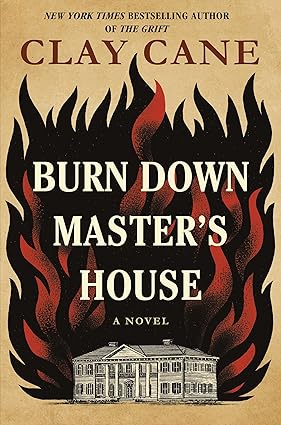
Burn Down Master’s House by Clay Cane takes place over about thirty years stretching from Pennsylvania to South Carolina, with the overarching story’s inciting event taking place in Goochland, Virginia. Author Clay Cane based these four interconnected stories off of his own ancestry, as well as real events in the 19th century American South pulled from newspapers and legal cases. The event connecting all four stories is the burning of Magnolia Row Plantation in an act of resistance, retribution, and revenge against the white enslavers. The ripple effect of this event touches numerous lives of the enslaved people on the plantation, creating an outward spiraling of hope for retribution and justice.
The first story focuses of two young men, Henri and James, who plan an escape together. Although the story of Henri and James passes by fast, we see a glimpse of their burgeoning romantic relationship. I later read in the author’s note that this book started as an entire novel about the relationship between Henri and James, which I would’ve loved to read. However, their story is confined to only the first chapter where they face harsh and brutal abuse after an attempted escape. And what ensues is the monumental event of the burning of the plantation.
The second story follows Josephine, a child around Henri and James in chapter one, years after the destruction of Magnolia Row. Having carried with her, and nurtured, the seed of rebellion and the fierce determination to take her fate into her own hands, Josephine follows in the footsteps of Henri and James. Divine retribution is enacted against her enslavers in yet another satisfying way.
Story three follows enslaved woman Charity moving back and forth between PA and MD as she is “rented out” to a white woman. Charity meets an extraordinary free Black man in Gettysburg who owns his own blacksmith shop. Through him, she learns the state of PA recognizes freedom after six months spent in the state. Like those before her, Charity takes fate into her own hands to change her future for the better (but not without its heartbreaking challenges.)
The last story, and perhaps one of the most brutal, follows former enslaved man Nathaniel who has himself become a landowner and owner of souls. The author’s note explains that there are indeed historical accounts of Black enslavers. Reading Nathaniel’s desperate need for the approval of white enslavers, one can’t help but think of those in politics and pop culture today who harbor startling internalized racism and turn their backs on their own people and history. Nathaniel’s brutality and betrayal cuts deeper to the souls around him. The four stories wrap up in a satisfying way, braiding in elements of the former stories and coming full circle.
While the acts of retribution, revenge, and resistance in Burn Down Master’s House are satisfying for the reader, I wished this book had been a full novel rather than four interconnected stories. What’s more, the author’s writing style of often telling over showing sometimes lessened the emotional impact–however, I gather this stylistic choice was made to condense many threads into separate stories rather than flesh everything out in a fully realized novel. There is no doubt the messaging in Burn Down Master’s House is important and timely, but readers should be warned these stories come with trigger warnings of violence, brutality, and SA.
 Home
Home 