

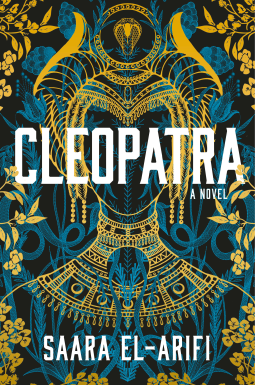
Cleopatra by Saara El-Arifi, not to be confused with the recently published I Am Cleopatra by Natasha Solomons, offers a humanized story of the famous Pharaoh while at that same time adding creative fantasy elements. The reader meets Cleo and her ever loyal handmaiden Charmian within the famous lighthouse of Alexandria. It, and the library, are favorite haunts of the young women who steal to these locations through a secret tunnel from Cleopatra’s palace quarters on Antirhodos.
El-Arifi’s Cleopatra is drawn to the study and practice of healing, having been quite literally marked by Isis since birth. The unique element of this rendition of Cleopatra is that everyone in her family, those descended of pharaohs and royalty, are born with a birthmark tied to an Egyptian god. Each member of the family is then given a special gift or power associated with the god who marked them from birth. I really loved this creative and fantastical detail. In the same vein, the Library of Alexandria has a literal tree of knowledge that blooms with scrolls–knowledge directly from the gods–which makes its eventual and infamous destruction all the more heartbreaking.
Although a skilled healer, the rest of Egypt does not know that Cleopatra’s skills are acquired through study and practice rather than magically bestowed upon her by Isis. Unlike her siblings who have already come into their god-given gifts, Cleopatra must hide her shame of having no supernatural gift from Isis (yet.) When she comes to power after her father’s death, her siblings opposing her rule and a weary faction of citizens use her suspected lack of gift from Isis as means to invalidate her rule as Pharaoh. Enter Julius Caesar, who Cleopatra must ally with to strengthen her claim on Egypt’s throne as well as to fight against the siblings who have turned against her. Unlike other renditions of Cleopatra’s life, El-Arifi’s version seems to have genuine emotion for Caesar. She is not “grin and bearing it” for her people, but rather an agent of her own destiny, pleasure, and happiness.
What’s more, this Cleopatra views her ride-or-die handmaiden Charmion as somewhere between lover and friend. Charmion is her truest confident without Cleopatra ever seeming to look down upon her given the differences of their ranks and social stations. El-Arifi’s Cleopatra is daring like the other interpretations, but also compassionate and empathetic with a strong moral compass in the face of her siblings’ brutalities. Despite the wonderful and creative fantastical elements sprinkled into this story, this novel is perhaps one of the more humanized versions of Cleopatra’s life, leaving the reader truly caring about her and those she holds most dear.
Cleopatra will be released February 24, 2026
*cover image from Assassin’s Creed Origins, art by Oleg Gamov*
 Home
Home 