

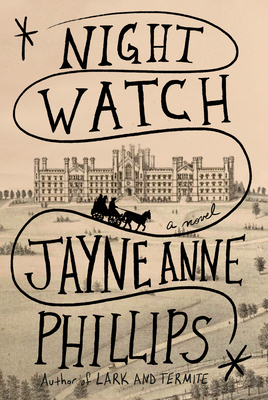
Night Watch by Jayne Anne Phillips follows a family though the American Civil War from its start to tenuous post-war reconstruction. The novel begins in 1874 West Virginia with young ConaLee and her mute mother Eliza being taken to the Trans-Allegheny Lunatic Asylum by a man known only as “Papa,” but who is not, in fact, ConaLee’s birth father. From there, the story backtracks to other character perspectives in an unraveling of the family’s story, such as through ConaLee’s “grandmother” Dearbhla, an elderly Irish woman who has a mystical side. Dearbhla raised ConaLee’s birth father as her surrogate son, his true parentage an enslaver and an enslaved woman. Dearbhla also partly raised Eliza, a daughter of the enslaver family, pointing to an uncomfortable familial subtext that is not really addressed or known by the majority of the characters.
When ConaLee’s father (there’s a reason he is not given name early in the novel) is injured as a solider for the Union in the American Civil War, he convalescences under a Dr. O’ Shea. While he eventually regains his health, he suffers from amnesia and does not remember his family. He takes the surname O’ Shea and effectively begins a new life. As Eliza receives treatment for her mental health condition at the asylum, ConaLee acting as her nurse, the reader uncovers the reason for Eliza’s muteness and catatonic state. Here we come to the large chunk of the story hinging on brutal, uncomfortable, and graphic depictions of SA. I, and many readers, am not a fan of SA plot points in both pushing a narrative forward and encompassing a characters’ arc.
Night Watch is written in a highly stylized way that will not be every reader’s cup of tea. At times, there is almost too much nuance and subtext that it’s hard to understand what is actually occurring in a scene. I understand writing in an artful way to avoid being too on the nose, however, when those stylistic choices hinder understanding plot points or even simple logistics, it hinders not only the reader’s ability to fully connect with the characters, but also the reading experience as a whole.
 Home
Home 