
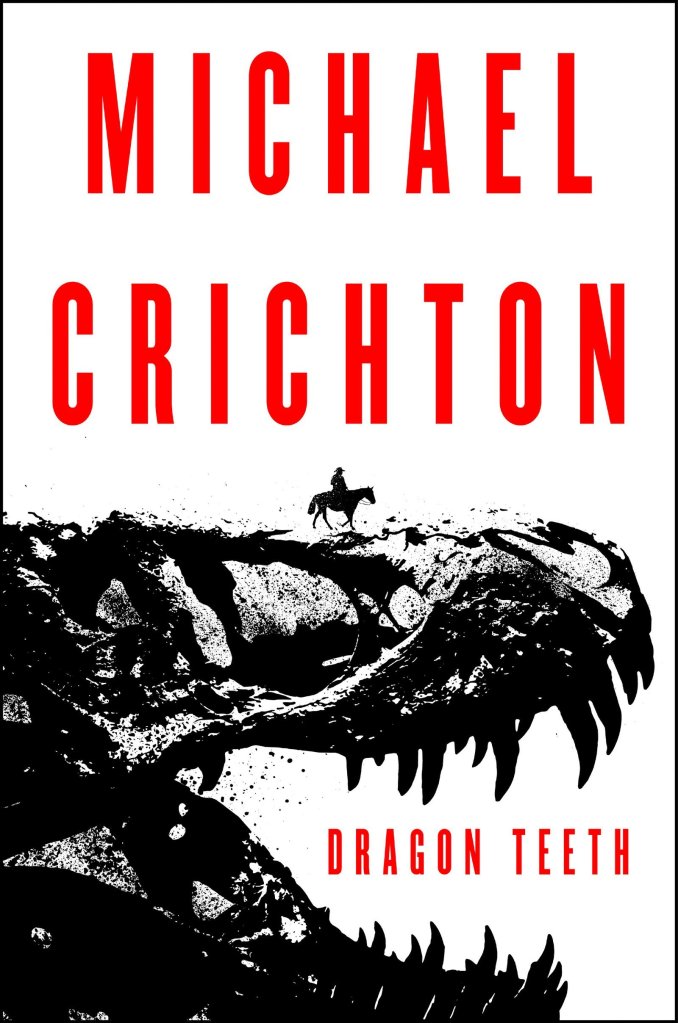
For as much as I enjoy Jurassic Park (the movie,) I’ve actually never read any Michael Crichton but have always intended to. I randomly stumbled across Dragon Teeth, released posthumously, which centers around the “bone wars” of early paleontology in the 1870s American West. Dragon Teeth follows 18-year-old William Johnson of Philadelphia, a Yale student who makes a bet with a bully that he will venture out to the dangerous west for a dig with Yale Paleontology professor, Marsh. Johnson is at once out of his depth, convincing Marsh to let him go if he serves as the expedition photographer. Coming from Rittenhouse Square money, Johnson is able to quickly buy all the photography equipment he needs and learn the trade to convincingly portray an expert photographer on the trip.
On the rail journey west, Marsh’s manipulative and conniving ways are soon brought to light–leaving Johnson abandoned in a frontier town and at the mercy of University of Pennsylvania professor, Cope, Marsh’s rival. However, Cope is not the harsh, cutthroat man Marsh claimed him to be, but rather a reasonable man passionate about paleontology and uncovering bones in the west–no matter the dangers. Johnson faces a brutal coming of age in the western territories, enduring attacks from drunken US cavalry, indigenous peoples defending their land, and lawless gunslingers in frontier backwaters. As such, Johnson eventually finds himself as the sole protector of hundreds of bones–stranded in the west with no money or connections, with the impossible goal to get back to Professor Cope in Philadelphia.
Dragon Teeth‘s premise was interesting, as the late 19th century American West is often associated with cowboys and gold panning, and seldomly recognized as the stage in which American Paleontology flourished. The structure and style were a little different in that many chapters would open with a sort of non-fiction historical context before getting back into Johnson’s narrative. What’s more, Johnson’s journal is often quoted as primary sources are in research papers. I’m not sure if these style choices are normal for Crichton, or if non-fiction historical context was added to support an unfinished manuscript? Dragon Teeth also read more like a play-by-play of action rather than dwelling on character development, which speaks to Crichton’s screenwriting background. In fact, Dragon Teeth would probably be better served as a film rather than a book. That said, the plot driven-first aspect made connecting with, and understanding motivations of, Johnson or the other characters a struggle.
 Home
Home 