

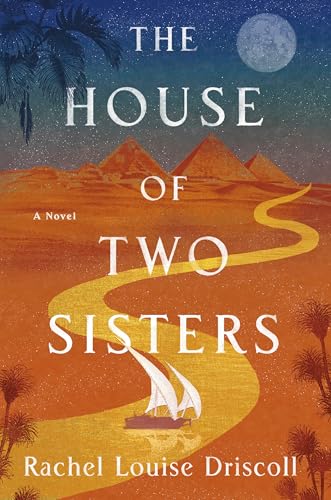
The House of Two Sisters by Rachel Louise Driscoll (titled Nephthys in the UK) follows Clementine “Clemmie”, daughter of a famed Victorian Egyptologist and “mummy unwrapper.” Clemmie ventures alone to Cairo to return one of her father’s (pilfered) artifacts that Clemmie believes has cursed her family. (Read into that the colonialism and superstition as you will.) Clemmie’s journey down (up?) the Nile to find the best place to return the artifact amulet is inter-spliced with flashback chapters from 1887 recounting Clemmie’s witnessing of one of her father’s “unwrapping” parties. While Clemmie instinctively finds the “fad” wrong and disrespectful, she cannot stop her father from reveling in his guests’ reactions to the mummy he has uncovered: conjoined twins. Although Clemmie begs him to stop, her father goes as far as to physically cut the twins apart.
The parallels between the sister mummies and the relationship between Clemmie and her own sister, Rosetta “Etta,” are beyond evident. Etta’s mind begins to unravel, setting Clemmie in motion to venture to Egypt to return the twins’ amulet. While abroad, however, Clemmie’s plan does not go according to her desire–this wouldn’t be a story if it didn’t! She teams up with English tourists, siblings Celia and Oswald, as well as the slightly suspicious and almost too curious Rowland. Clemmie is coerced into taking a boat with them down the Nile. Though her main objective is sidetracked, her journey ultimately leads to uncovering a grander scheme that speaks to British colonial exploitation of Egypt and her history. Colonialism is an important topic to discuss when writing a story about the English in 1890s Egypt, and though we read the story through Clemmie’s eyes, Egyptian Mariam is a stand-in for the Egyptian perspective. She serves as a sort of reality check for Clemmie, but her role as a character isn’t fully developed beyond a few lines of description speaking to her and her father’s greater purpose in preserving and protecting Egypt’s history. Although an Egyptian character, she isn’t given enough “screen time” in this story of Egypt.
The House of Two Sisters started in an engaging and descriptive way that made me want to know more, however as the story progressed, the writing became more of a summary of events. What’s more, the author often drove too on the nose points home. Perhaps these choices were at the request of an editor or publisher, as readers are not often given enough credit for being smart or perceptive enough to pick up on nuance.
 Home
Home 