

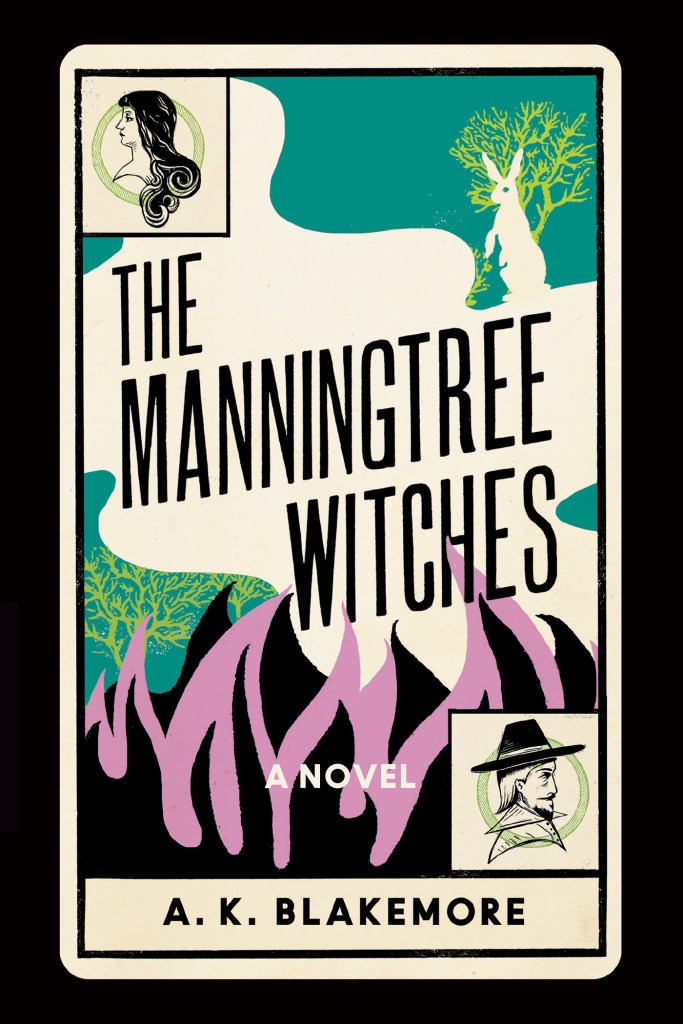
The Manningtree Witches by A.K. Blakemore follows Rebecca West during the 17th century witch hunt craze in England, spearheaded by “Witchfinder General” Matthew Hopkins (again, I couldn’t help picturing Vincent Price given his film.) Similar to Margaret Meyer’s The Witching Tide, the women of Manningtree are one by one accused by Hopkins and his associates of witchcraft. Having read not only The Witching Tide, but also the non-fiction Ashes and Stones, I found myself quite familiar with the this world and its methods of finding, inspecting, and punishing women for their alleged witchcraft. That said, it’s still a topic I can and will continue to read about.
Rebecca West sees a curious white hare, thinks she sees the devil in her friend’s water bowl, experiences fantastical and erotic dreams, has an all encompassing infatuation with the man who is teaching her to read and write–all these parts make the whole of her suspicion, and not necessarily fear but fascination with the prospect that she may indeed be stalked and influenced by the devil. But when Rebecca, her mother, and a few other village women are arrested and thrown in jail, her outlook begins to change. Blakemore gives an accurate, albeit brutal, account of how women were strip-searched by strange men for any mark upon their body that could be considered a teat from which they suckled their imp or familiar. West and the Manningtree women are treated worse than animals, stuck in a pitch dark cell with little to no food, lice and vermin abound, overflowing bathroom bucket, and on top of this they are periodically taken out to be compelled to confess to the Witchfinder General Hopkins.
West, at her mother’s encouragement, seizes the opportunity to save herself by effectively playing the system. Again, having just read true accounts in Ashes and Stones, many accused women did indeed offer vivid and fanciful confessions if only for the reprieve from torture, but also there is no doubt their words were influenced by delirium or hallucinations brought on by malnourishment, dehydration, and prolonged solitary confinement. Blakemore presents us with a world unscrupulous in its brutality (physical and psychological), objectification, and othering of women. I need not state the obvious in its parallels with today’s world.
A.K. Blakemore’s prose is gorgeous and creative. Her unique wording, descriptions, and explanations are a vivid feast (if at times perhaps too enthusiastic with the thesaurus, which some may find irksome.) Overall, The Manningtree Witches is one part social history, one part historical fiction, one part social / gender commentary. Blakemore’s talent as a writer in crafting unique turns of phrases is stunning. I can’t wait to read The Glutton!
 Home
Home 