

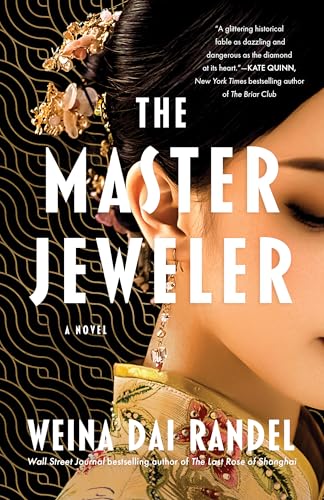
Weina Dai Randel’s The Master Jeweler opens in 1925 when 15-year-old budding artist and Harbin local Anyu discovers an exquisitely made Faberge egg in the snow (which turns out to be The Winter Egg.) She soon after meets its owner, Russian master jeweler Isaac Mandelburg, who has been tasked with protecting the egg in the fall out of the Russian Revolution. In exchange for returning the egg, Isaac extends an offer to protect and house Anyu in Shanghai.
When fate forces her hand, Anyu leaves everything she’s ever known behind to travel to Shanghai at the promise of a stranger. Here, she makes a new life with the House of Mandelburg, eventually earning the trust of Isaac and his family enough to apprentice as a jeweler with the ultimate goal of becoming a master jeweler. From brutal gangsters to the glittering high society of Shanghai, to tenuous pre-war Hong Kong, Anyu experiences both social and personal upheavals, as well as career highs and lows in the jewelry trade.
The premise of a Russian master jeweler on the run and his mentorship of a woman in the trade is what first prompted me to pick up this book. While the opening was promising, The Master Jeweler progressively devolves both in character development and technical execution. Narratively speaking, one of the main plot points is that Anyu, having met first met Isaac when she was 15 and he was in his 40s, is inexplicably in love with Isaac. She lets him know this very early on, but he shuts it down due to their age gap and the fact that he cannot be in a relationship with someone who is not Jewish. The readers are continually told of Anyu’s love for and fixation on Isaac, but we don’t really know why other than he took her in and allowed her to apprentice to him. I did not feel or see a slow burn, only the author telling us that there was. This is all to say nothing of being absolutely turned off by the age difference and her being at a gross disadvantage in their power dynamics. We are told she loves jewelry-making, but her career is so closely tied to her unexplainable love for Isaac. There are other men who come and go, with Anyu really acting her age in her inability to process her emotions. I didn’t buy Anyu’s motivations or “connections” with any of these men because we hardly experience her interacting with them at all. From about 40% onward the story relies almost solely on telling versus showing, with huge and disconcerting time jumps happening. Major events occur without much feeling attached to them even though we are told there are. The last 10-15% of the book seemed incredibly rushed, as if the publisher decided they wanted more and the author was made to quickly write a summarized version of a series of major events. We are told all of these, what should be, emotionally impacting moments such as marriages, deaths, etc. but they all come off as hollow because they read as a timeline summary. The person who turns out to be the villain falls flat because they only show up near the end of the book, we know only a handful of things about this person, and we don’t really know their motivation for pursing Anyu and the famed Russian eggs.
On a technical level, The Master Jeweler unfortunately suffered from a serious lack of editing. Much of the language and sentence structuring was awkward and stilted. There are countless sentences that could have benefited from tighter editing*. It’s not a good sign when I start editing a book in my head as I’m reading it. I don’t necessarily fault the author for this, as I get the impression the publisher must have put some rush deadline on this book and the proper attention to detail was not paid to this manuscript–which is a shame, because in general the premise is interesting and unique.
I hate to be critical of a book because I know how much work goes into it, but the publisher and the editor(s) assigned to this book really dropped the ball on development.
*Examples: “working in the workshop;” “holding her hand with one hand;” “on the day of the award ceremony that would announce the winner;” “it was early in the morning;” starting countless chapters and sections with “One day, xyx happened.”
 Home
Home 