
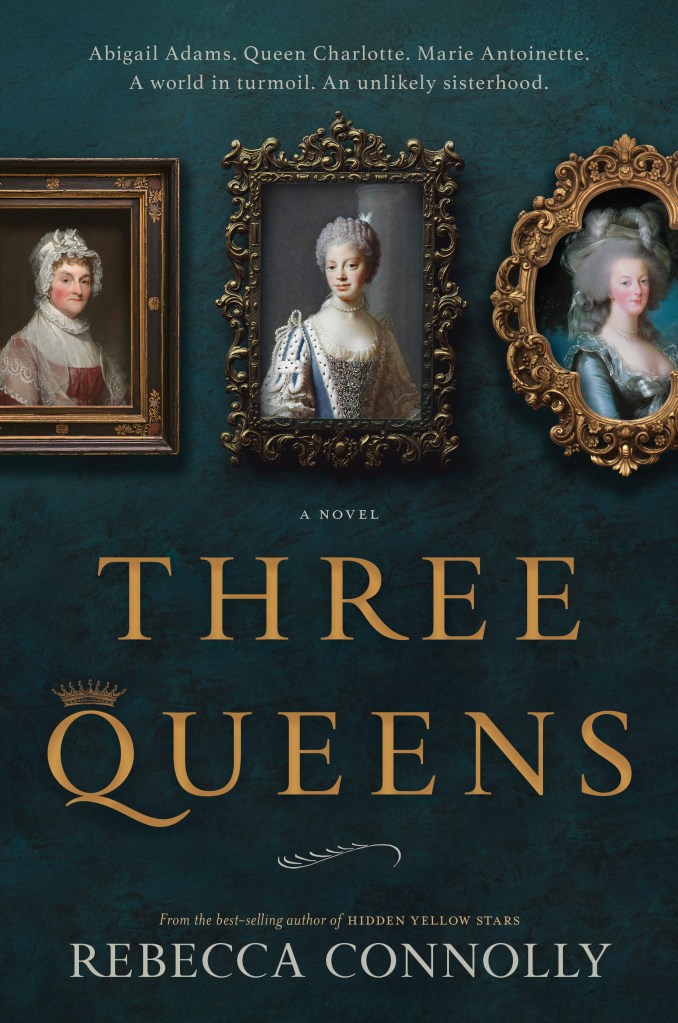
Three Queens by Rebecca Connolly follows Abigail Adams, Queen Charlotte, and Queen Marie Antoinette from the American Revolution through the French Revolution. Not to be confused with the twin release date book A Founding Mother, Three Queens has Abigail Adams take a bit of a back seat to the dramas unfolding for both Charlotte and Marie Antoinette. Great Britain’s queen grapples with her husband’s mysterious illness, as well as her irresponsible and politically scheming son the Prince of Wales. France’s queen deals with the infamous “affair of the necklace” and the subsequent growing animosity toward her and her family from the people of France.
Abigail first meets Charlotte after her husband takes the position of minister to Great Britain. There is an assumed animosity and chilly air due to the elephant of the American Revolution in the room, yet the two women recognize something in each other. Similarly, Abigail meets Marie Antoinette as a social gathering at Versailles where the two women take an instant liking to each other and form a mutual respect. Charlotte, meanwhile, maintains a correspondence with Marie Antoinette as they exchange details of their children, their day-to-day lives, etc. Connolly constructs a meeting among the three women a la the fictitious meeting between Queen Elizabeth and Queen Mary in the 2018 film Mary Queen of Scots; a tantalizing what if scenario? While Charlotte and Marie never met in person, they did indeed write to each other. And while we know Abigail and John Adams exchanged copious letters to each other throughout their separations, I do not believe Abigail carried on a correspondence with the two queens.
Connolly creates a sort of sisterhood of these three women–the strength of which carries to Marie Antoinette’s mind the day of her execution, which I found a bit of a stretch. In reality, I do not believe the queens of France and Great Britain would truly carry on such an intimate and close friendship/correspondence with Abigail–a common woman for all their intents and purposes. Despite John Adams’ new found status during and after the American Revolution, Abigail would likely still have been viewed as a whole other socioeconomic class. Thus, readers will have to suspend their disbelief for this friendship. What’s more, the marriages of Marie Antoinette and Charlotte with Louis and George, respectively, are depicted as quite lovey-dovey, perfect, and fluffy before George’s illness and before the violence of the French Revolution. I found these depictions to also be a bit unbelievable, as their relationship dynamics seem to lack any nuance in terms of power dynamics and gender views of the day.
The lives of these three women are no doubt interesting in their own rights, however, Three Queens fell a bit short for me with the many times I had to suspend my disbelief. Ultimately, the relationships (romantic and friendship) did not ring true. The latter half of the book favors Marie Antoinette’s story given the revolution, which makes the overall narrative uneven and unequally split among the three. What’s more, the author’s writing style often reverts to repetition of the same ideas just written in three to five different ways for impact. I found myself skipping all the repetition just to get to the advancement of action.

